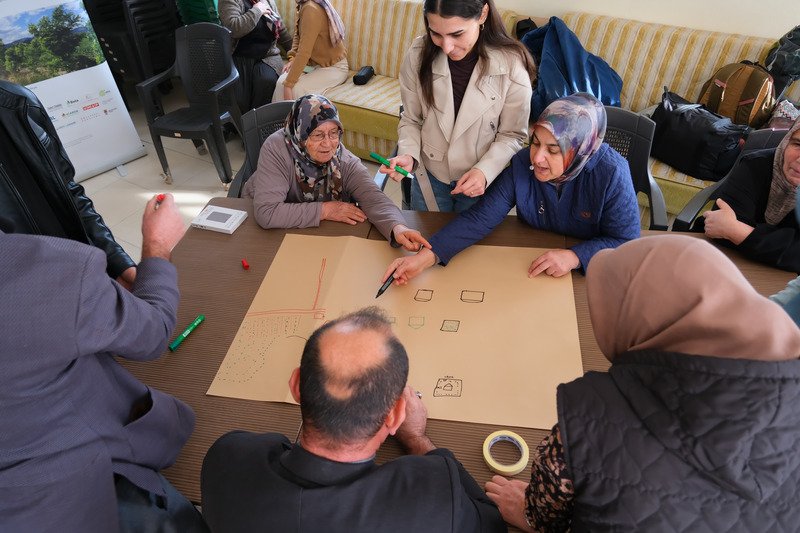
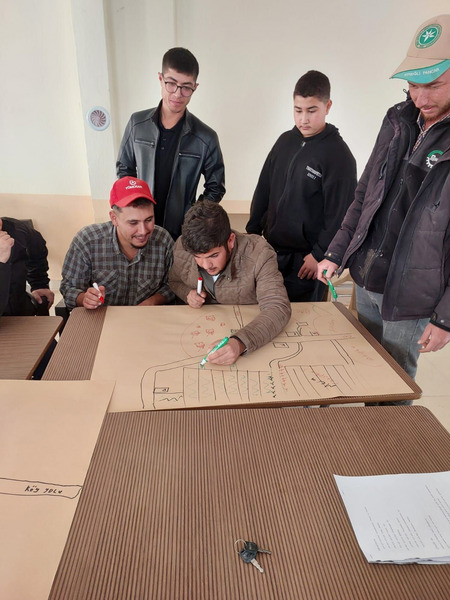
As part of TransforMed task socio-cultural drivers of agroforestry systems implementation, participatory solution-scanning workshops were implemented in the Anatolian region of Konya, with the active involvement of farmers and rural families from the community of Burunoba. The initiative aimed not only to identify technical barriers to agroforestry, but also to understand local perceptions and strengthen community agency in landscape transformation.
The region faces an extremely arid climate (200–300 mm of rainfall per year), strong winds and very cold winters. While pilot initiatives have shown that agroforestry can reduce wind erosion through windbreaks and improve soil and fodder availability by enhancing rangelands with shrubs, scaling up these practices remains a major challenge.
A structured participatory process was co-designed with local partners (DKM, BDIARI) before being implemented with the community. This first workshop focused on jointly testing and refining the methodology, using participatory mapping to locate challenges in farming landscapes, prioritising the most critical issues, and conducting a collective visioning exercise. A second workshop then applied the refined approach directly with the Burunoba community.
Participants first mapped obstacles affecting tree planting, then jointly explored locally driven strategies to overcome them. The process was designed to foster local agency and position farmers as key actors of change.
Beyond the technical dimension, the workshops revealed a strong social acceptance of participatory approaches. Community members actively engaged in drawing rangelands, orchards and windbreaks on local maps, which helped them express both interests and constraints linked to known places. which is positive for future activities carried out by local partners.
The main challenges identified by the community included difficulties linked to road transport and machinery, pesticide use damaging young trees, grazing conflicts, limited access to diverse seeds for windbreaks, and a landscape historically and structurally shaped by conventional agriculture. Despite these constraints, local people expressed a clear willingness to improve their land with trees and to remain actively involved in future agroforestry-based landscape transformation, combining technical advantages with sensory satisfaction and well-being for greener environments.
By joining a rigorous participatory process with strong community engagement and social ownership, the solution-scanning workshops laid the foundation for a locally rooted agroforestry development in the Konya region.
This workshop will also be organised in Morocco and Tunisia during the spring.
 tap and then scroll down to the Add to Home Screen command.